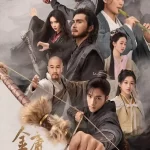
Duel on Mount Hua
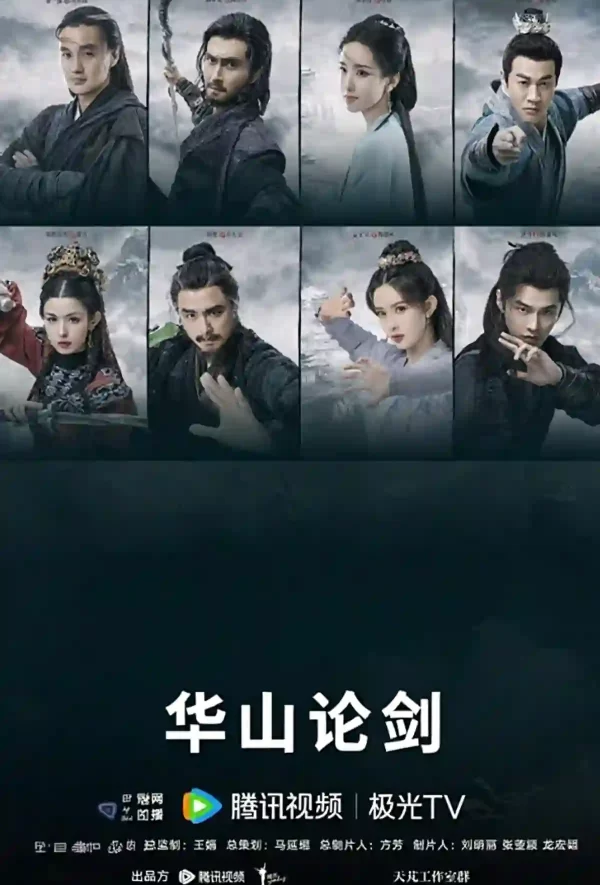
Cast & Crew











Plot Summary and Unit Cores
“The Nine Yin Manual”: The tragic darkening of Mei Chaofeng
Mei Ruohua (played by Meng Ziyi), daughter of a maritime merchant, suffers a massacre of her family and is forced to flee the Jianghu. She later becomes a disciple of Peach Blossom Island and takes the name Mei Chaofeng. She develops feelings for her senior brother Chen Xuanfeng (played by He Yu), but due to misunderstandings and a desire for revenge, she turns to stealing martial arts manuals. She masters the “Nine Yin White Bone Claw” and becomes infamous as one half of the “Black Wind Twins,” yet her emotional entanglements and the cost of her actions ultimately push her towards a tragic fate.
“East Heretic, West Venom”: The disillusionment of Jianghu’s early days
This unit depicts the meeting and conflict between Huang Yaoshi (played by Zhou Yiwei) and a young Ouyang Feng (played by Gao Weiguang) in the early days of their Jianghu experience. Huang Yaoshi is portrayed as aloof and transcendent, while Ouyang Feng displays innocence and obsession. Their ideological differences and Jianghu incidents weave a complex web that plants the seeds of their later antagonistic relationship as the “East Heretic” and “West Venom.”
“Southern Emperor, Northern Beggar”: Brotherhood, hatred, and moral choices
Duan Zhixing (played by Peter Ho), heir to the Dali Kingdom, escapes palace constraints and becomes close friends with Hong Qigong (played by Ming Dao), a disciple of the Beggars’ Sect. Drawn by their fathers’ grudges and power struggles, their friendship gradually turns into conflict. This unit showcases martial arts clashes such as the “Yiyang Finger” and “Eighteen Dragon Subduing Palms,” exploring the tensions between chivalry and personal vendetta.
“Clash of the Five Greats”: The ultimate showdown atop Mount Hua
As clues from The Nine Yin Manual reemerge, the main storylines of the Five Greats converge at the peak of Mount Hua. An original character, Jialan (played by Pei Jiaxin — check official cast list), becomes a key figure in the search for the manual. Wang Chongyang (played by Yu Jinwei) finally asserts his leadership in this climactic duel. However, the appearance of hidden forces triggers a grand battle of good versus evil, serving as the series’ final crescendo.
Top 10 Highlights and Controversies
-
Narrative Innovation: Uses an anthology format to deeply explore the backstories of supporting characters and the Five Greats in each unit, offering a macro-level narrative restructuring attempt.
-
Female Perspective and Character Depth: Meng Ziyi’s Mei Chaofeng receives significant screen time and psychological portrayal, regarded as a more comprehensive depiction of the character; however, some viewers criticize the handling of her motivations as controversial.
-
Aesthetic Experimentation: Each unit displays stylistic differences (some call East Heretic, West Venom more artistic, while Southern Emperor, Northern Beggar leans towards light comedy). Critics see style diversity as both an advantage and a risk.
-
Youthful Reinterpretation of the Five Greats: Some viewers feel the characters have been “softened” and the original master aura weakened; supporters welcome the more humanized rewriting.
-
Action Design: Real-location fight scenes atop Mount Hua and some outdoor filming locations (reports mention Zhangjiajie, Kanas, etc.) receive praise; however, certain slow-motion or stage-like fight scenes are criticized by some viewers as lacking intensity.
-
Original Characters: Original roles like Jialan have been accused of pushing the plot artificially but are also seen as serving the overall narrative needs.
-
Dialogue and Cultural Elements: The series retains several Jin Yong-style moralities and iconic lines but some critics note a noticeable modernizing tendency in certain dialogues.
-
Veteran and New Generation Actors: Performances by veteran actors such as Zhou Yiwei, Zhang Fengyi (if guest starring), and Gao Weiguang are considered highlights (refer to cast list).
-
Music, Costume, and Art Direction: The overall score and production design are praised by some media for being well-researched, although debates persist about whether the styling is overly modern.
-
Reception Gaps: The series shows clear divergence in audience and critic reception across units (e.g., East Heretic, West Venom vs. Southern Emperor, Northern Beggar), with Douban and online communities reflecting polarization due to stylistic differences.
Controversy Summary and Era Significance
-
Adaptation Choices: The series opts for a “unit-based, rewriting and expansion” approach to revisit Jin Yong’s world. Its strength lies in broadening the narrative scope; its weakness lies in potential disconnect with original fans’ expectations.
-
New Path for Wuxia Dramas: The producers’ attempt to refresh wuxia expression with film-level directors and episodic narration is notable; whether it can balance style with fan expectations remains to be seen.
Closing Quote
"The duel is for fame; descending the mountain is to protect the people." When a classic is deconstructed and no longer simply replicated, but attempts to capture the characters’ vulnerabilities and choices, Duel on Mount Hua at least takes an important step forward in wuxia genre innovation.
-
- Genres
- Release Date2025 年 7 月 26 日
- Languages
- Regions
- Production Companies
- Presenters
- ViewershipThe effective broadcast market share on the first day of broadcast was less than 2%
- Runtime0 hour 45 minute
- Picture Format
- Follows
- Version of
Adapted from Jin Yong’s novel The Legend of the Condor Heroes
- User Reviews
- IMDb RatingN/A