

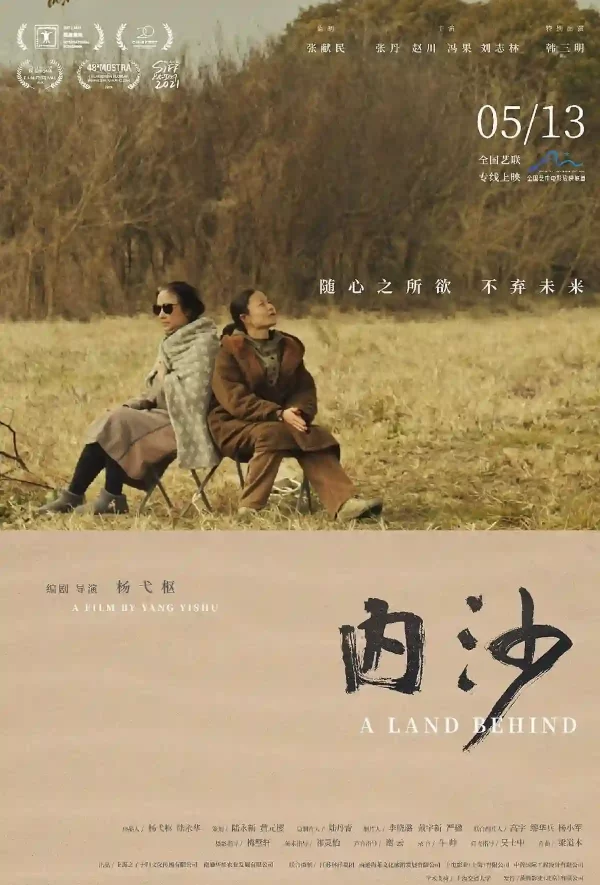
A Land Behind
Cast & Crew
Core Narrative: The Collapse of a Utopian Organic Farm and the Silent Dialogue of Three Generations of Women
Set against the backdrop of the Yangtze River estuary on Chongming Neisha Island, the film follows young woman Xiao Yu (played by Zhang Dan), who joins the idealistic teacher Tong (played by Zhao Chuan) in running an organic farm, attempting to build a living utopia based on the principle of "making healthy food affordable for the poor." However, the sudden arrival of Xiao Yu's mother (played by Feng Guo), who has lost her sense of belonging after a forced relocation in her hometown, forces Xiao Yu to confront the trauma of her family's past. On a stormy night, when teacher Tong compromises and signs an acquisition deal, the scene of Xiao Yu silently gazing at a dying ox in the barn becomes a metaphor for the collapse of the idealist's spirit.
Director Yang Yishu uses the "storm" as a narrative turning point, intertwining three lines:
Land Crisis: The island, piled with shifting sands, symbolizes modernity's consumption of nature, as the farm devolves from an "organic paradise" into a "resource for development" in the eyes of real estate developers.
Family Fracture: The contrast between the old house number carried by the mother and Xiao Yu's planting journal symbolizes the loss of memory in the urbanization process.
planting journal symbolizes the loss of memory in the urbanization process.
Disillusionment of Ideals: Teacher Tong's transition from "not selling a single genetically modified seed" to signing an acquisition agreement reflects the intellectual's spiritual compromise under real-world pressures.Depth of Characters: The Authentic Portrayal by Non-Professional Actors
Xiao Yu (played by Zhang Dan): The amateur actress' clumsiness conveys the purity of the idealist, from stubbornly tilling the soil to silently burning the farm contract. The long shot of her barefoot stepping into the river mud is hailed by critics as "the land's final embrace."
Teacher Tong (played by Zhao Chuan): As a theater director, Zhao Chuan captures the character's transition from impassioned speeches to solitary late-night pondering, depicting the tragic "awakening and downfall" of the intellectual. His line "We didn't lose to capital, but to time" directly points to the structural contradictions in agricultural modernization.
Mother (played by Feng Guo): Professor Feng Guo from Shanghai University impresses the audience with her "silent performance," conveying the unspoken trauma of the uprooted generation through details like gazing at old photos and caressing the ruins of demolition.
Production Highlights: Naturalistic Aesthetics and Surreal Metaphors
The film crew spent two years rooting themselves in Chongming Island, using natural lighting and sync sound recording, with a 4:3 aspect ratio to emphasize the oppressive sense of the land. The key scenes are imbued with ingenious design:
The Ox Barn Oracle: The dying ox's reflected image in the burning farm is a surrealist device prophesying the inevitable collapse of the utopia.
The Riverbank Ritual: The scene of Xiao Yu scattering organic seeds into the river, accompanied by Mongolian throat singing, metaphorizes the contemporary translation of the land's spirituality.
The director also experiments with "non-linear editing," interweaving the mother's past (mountain seclusion), Xiao Yu's present (farm struggle), and teacher Tong's future (compromised emptiness), constructing a spiritual labyrinth across the time dimension.Social Responses: Controversies and International Acclaim of Intellectual Cinema
The film's release has elicited polarized reactions:
Criticism: Some audiences find the "organic agriculture saving the poor" idea too idealized and the dialogue "as obscure as an academic thesis."
Artistic Acclaim: International film festivals have praised the film for "reflecting the global scars through the mirror of the land," with the Girona Film Festival jury even likening it to the "Asian version of The Horse of Turin."
The focal point of controversy centers on the open-ended finale - Xiao Yu sitting alone on the sandbar, allowing the river to submerge her feet, which is interpreted as either "the end of resistance" or "a metaphor for rebirth."Viewing Guide and In-Depth Analysis
Screening Information: Nationwide art film screening network, runtime 124 minutes; post-screening director talks organized in cities like Shanghai and Guangzhou.
Recommended Highlights: For those interested in "poetic cinematography," the cross-cutting sequences on the storm night and the surreal ox barn segment are must-sees; for exploring "social criticism," focus on the real estate tycoon Professor Zhu's (played by Liu Zhilin) capitalist rhetoric.
Historical Context: Chongming Neisha Island is a young alluvial island formed by the Yangtze River sedimentation, and the film's production coincided with ongoing ecological protection controversies, imbuing the work with strong realistic references.
"A Land Behind" sets a new benchmark for independent Chinese cinema with the creative philosophy of "the land remains silent, while the camera speaks." As director Yang Yishu stated, "This film does not provide answers, but allows the audience to hear the dialogue between themselves and the times, amidst the river winds and sandbanks."
- Genres
- Release Date2025 年 5 月 13 日
- Languages
- Regions
- Runtime2 hours 4 minutes
- Picture Format
- User Reviews
- IMDb RatingN/A
